


From Receiving an Opportunity to Creating Opportunities for Thai Start-ups
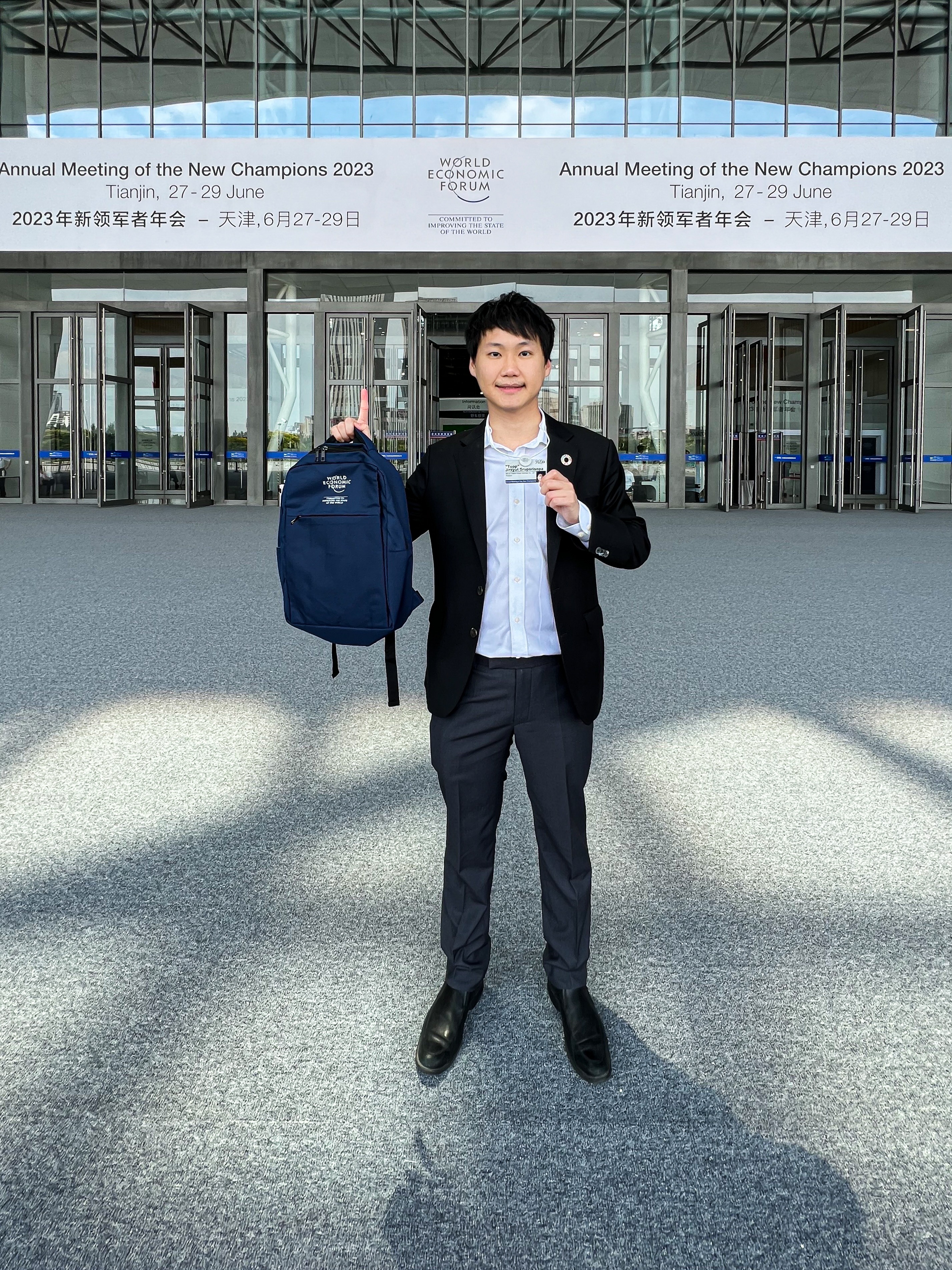
Once again, I was invited to attend the World Economic Forum: 14th Annual Meeting of the New Champions, also known as Summer Davos 2023. This was the 14th meeting of its kind, held between 27-29 June in Tianjin, People's Republic of China, after a four-year hiatus. The conference brought together 1,500 attendees, including leaders from business, government, civil society, academia, and international organisations from over 90 countries. About 20% of the leaders at this conference were from the ASEAN region, which I feel is not a large proportion, meaning over 80% came from a diverse range of countries across the globe.
Typically, the Summer Davos meeting in China differs from the Winter Davos held in Switzerland, which I attended from the 16th to the 20th of January. The winter meeting focuses on the current challenges facing the world, and the attendees are often well-known public figures. This meeting, however, is themed "The New Champions" and is a gathering of new-generation leaders from various sectors—you could say it's a congregation of people who will become the big names of the next decade. The main topic of discussion this year was the new era of entrepreneurs and their dynamic role in driving the future economy.
For this year's meeting, in addition to Bitkub, the organisers allowed us to invite partners who met their criteria to join. Bitkub therefore coordinated with the Thai Startup Trade Association to invite two leaders from leading Thai start-ups: Khun Kla, CEO of Wisesight, a leader in understanding online consumer behaviour in Thailand, and Khun Paul, CEO of aCommerce, a provider and driver of e-commerce businesses in ASEAN. This allowed us to form a team of Thai leaders to participate in exchanging ideas and discussing future economic perspectives at this forum.
From a Committed Mission to a Voice on the Global Stage
From our beginnings to the present day, my team and I at Bitkub remain committed to our goal of making Bitkub a strong bridge that connects people to opportunities in the digital world and a bridge to the future. This is to create new opportunities for Thailand to rise as a leader in the digital world. That's why I'm so determined when I get the chance to join international forums like this. Not only do I get to hear new ideas and perspectives from experts in many fields, but this year—my second year attending a WEF conference—I was honoured to share my vision on two panels: "Education Disrupt-Ed" and "Beyond the Hype: Non-Fungible Tokens for Business". These panels discussed the future of education and how NFT technology is more than just a passing trend for businesses.
On the topic of education, a survey found that within the next five years, the skills of over 44% of the global workforce will become obsolete and replaced by various technologies. In response, the WEF has initiated a project called Education 4.0 to prepare learners from childhood for the Fourth Industrial Revolution, readying them for the future of work and society. It aims to leverage educational innovation to make learning more learner-centred. The core of this concept consists of four skill sets: Global Citizenship Skills, Innovation and Creativity Skills, Technology Skills, and Interpersonal Skills. It also includes four learning experiences: Personalised and Self-paced Learning, Accessible and Inclusive Learning, Problem-based and Collaborative Learning, and Lifelong and Student-driven Learning. There are currently 16 pilot projects running in collaboration between the public and private sectors worldwide to inspire everyone involved—from learners and teachers to policymakers and entrepreneurs—who seek best practices for transforming and improving the quality of education.
The other panel was on technology that is more than just a temporary hype. In a few years, the metaverse will be a technology that revolutionises many industries, such as manufacturing, education, public health, and entertainment. An example of using the metaverse in manufacturing is simulating a physical object as a virtual "digital twin" to revolutionise the production process, making it more efficient and sustainable. This allows us to use technology to analyse the digital twin to see how it would be affected in the real world. The metaverse can also be used for purposes beyond production, such as training workers in simulated environments, facilitating collaboration between different sectors, product design, and even remote machine maintenance. The development of metaverse technology relies on a combination of several technologies, including AI, IoTs, Cloud, and even NFTs.
From Change to the Future Direction that Thailand Must Follow
An undeniable change is the Digital & Green Revolution, which will become the main theme of our future direction. Amidst geopolitical tensions between China and the United States, China has affirmed that both nations must continue to cooperate on trade because the world is too deeply interconnected to decouple. However, decoupling will occur in technology development, as the U.S. has restricted access to its latest technologies, whilst China is overhauling its entire infrastructure. China realises that the world has reached an "inflection point," where various technologies have combined to the verge of a paradigm shift. This means we are entering a phase of mass adoption for several world-changing technologies like AI, the metaverse, and green energy. With this change, China predicts its middle-class population will double from 400 million to 800 million people, becoming a massive group with significant purchasing power and influence on the future global economy.
Overall, the world is changing very rapidly. It can be said that there will be more change in the next 5 or 10 years than in the past 50 years combined. Thailand is very fortunate to be in the Asia-Pacific, a region with high economic potential where a great deal of capital will flow back as the global economy recovers, creating many new economic opportunities. I believe that if we can catch this global trend and get on board with this wave of change, we can certainly transform into a high-income nation. Thailand has the necessary resources and talented people; what we need is targeted support for labour skills, good national infrastructure, and coherent policies to drive technology forward
Finally, for me, sharing ideas and perspectives on the future of technology and the economy from world leaders is another mission to help steer our country in the same direction as the changes that are happening. Although Thailand's economy may not be large enough to influence and set the world's direction, I firmly believe that we can move in the right direction, and at a sufficient speed, to prepare for this new wave of industrial revolution.
Topp Jirayut Srupsrisopa
Founder and Group CEO, Bitkub Capital Group Holdings Co., Ltd.